ELLIPROF
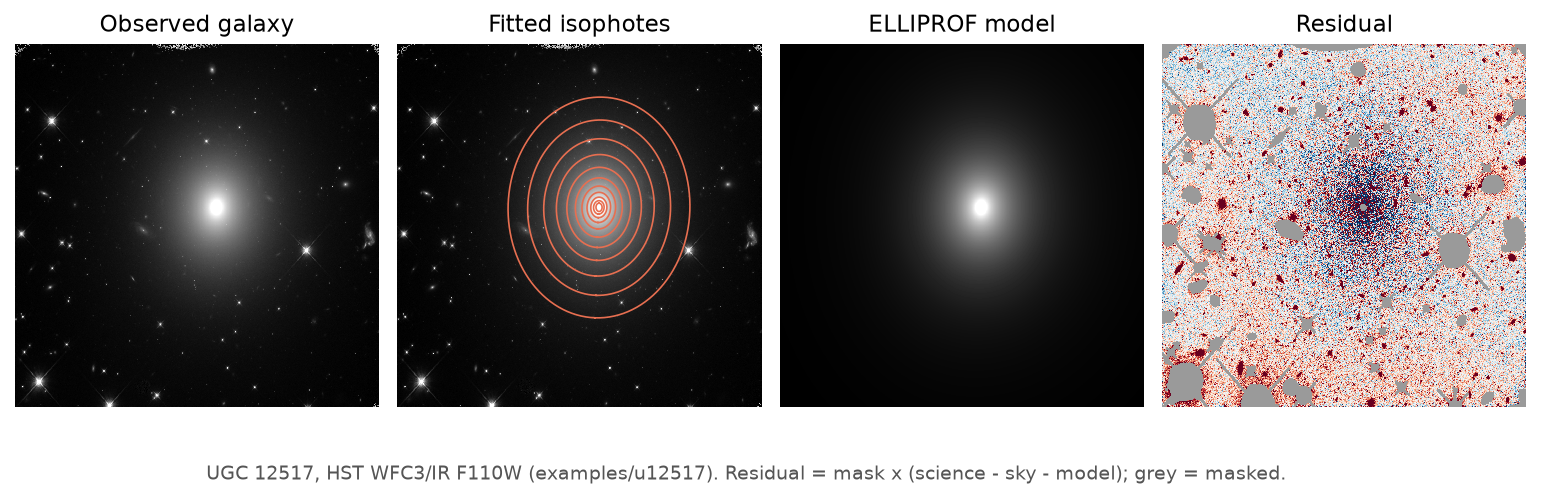
Fit elliptical isophotes to a galaxy image, and measure how its brightness, shape and orientation change with radius. ELLIPROF also builds a smooth model of the galaxy and the residual image left when that model is subtracted.

What ELLIPROF does
You give ELLIPROF a FITS image, an initial galaxy centre and the range of radii to fit. It fits a sequence of nested ellipses, one per radius. For each ellipse it measures:
- the intensity of the isophote;
- the centre, ellipticity and position angle;
- the logarithmic slope of the intensity profile;
- the 3rd- and 4th-order deviations from a pure ellipse, including the classic boxy/disky term (optionally the 6th order instead of the 3rd); see Harmonic analysis.
From the fit it can build a model image of the galaxy and a residual image (data − sky − model). The residual shows what the smooth model does not describe: dust, disks, shells, tidal features and, at the smallest scales, the pixel-to-pixel brightness fluctuations that surface brightness fluctuation (SBF) distances rely on.
ELLIPROF works best for smooth light distributions: elliptical galaxies, lenticulars, bulges and other early-type systems.
How it works, in one picture
flowchart LR
    A["FITS image<br/>+ sky, mask"] --> B["fit an ellipse<br/>at each radius"]
    B --> C["harmonics:<br/>3rd (or 6th), 4th order"]
    C -- "repeat NITER times<br/>(default 5)" --> B
    C --> D["radial profile<br/>-o n1234.dat"]
    D --> E["smooth 2-D model<br/>-m n1234.prf"]
    E --> F["residual<br/>--residual"]
The isophote fit, the harmonic analysis and the model are the original ELLIPROF, compiled unchanged. Reading any FITS image, subtracting the sky, applying the mask and writing the profile, model and residual files are done by the elliprof package around it. The full, step-by-step diagram is on How ELLIPROF fits a galaxy.
ELLIPROF is not an SBF pipeline. It fits isophotes and produces a smooth galaxy model and a residual image, which are inputs to an SBF measurement. The power-spectrum analysis, the corrections for globular clusters and background galaxies, the calibration and the distance itself are done by other software and by the researcher. See ELLIPROF's role in SBF.
Install and run
Prebuilt packages exist for Linux, macOS and Windows, and Python 3.6–3.14. No compiler is needed. See Install, then the 5-minute quick start.
Where to start
New to galaxy isophotes
Start with What is an isophote?, then run the quick start and the UGC 12517 tutorial.
You know surface photometry
Go to How ELLIPROF fits a galaxy for the exact conventions, then The profile, Harmonic analysis and the command-line reference.
You are preparing SBF data
Read Surface brightness fluctuations, ELLIPROF's role in SBF and A residual for SBF work.
ELLIPROF was originally developed by John Tonry as part of MONSTA.
Maintained by Ehsan Kourkchi (Edwin Kay) · Email: ekourkchi@gmail.com ·
Source code ·
About and credits