Surface brightness fluctuations
Surface brightness fluctuations (SBF) are one of the most precise ways to measure distances to early-type galaxies (ellipticals, lenticulars and bulges). The method was introduced by John Tonry and Donald Schneider in 1988. Distances to individual galaxies are now measured with uncertainties of about 4–5% out to around 100 Mpc (Jensen et al. 2021; Cantiello & Blakeslee 2023).
This section explains the idea, what ELLIPROF contributes, and what lies beyond it.
ELLIPROF is not an SBF pipeline. It supplies the smooth galaxy model and the residual image that an SBF measurement starts from, the role it has had in published SBF analyses since the I-band SBF Survey. Everything after that (the power spectrum, the corrections for globular clusters and background galaxies, the calibration and the distance) is done by other software and by the researcher. See ELLIPROF's role in SBF.
The idea in one picture
A galaxy too distant for its stars to be resolved still looks slightly grainy. Each pixel collects the light of a finite, random number of stars, so neighbouring pixels differ in brightness even where the galaxy is perfectly smooth on average.
The graininess depends on distance:
- a nearby galaxy puts few stars in each pixel, so the pixel values fluctuate strongly;
- a galaxy twice as far away puts four times as many stars in each pixel, each four times fainter. The average surface brightness is the same, but the image is smoother.
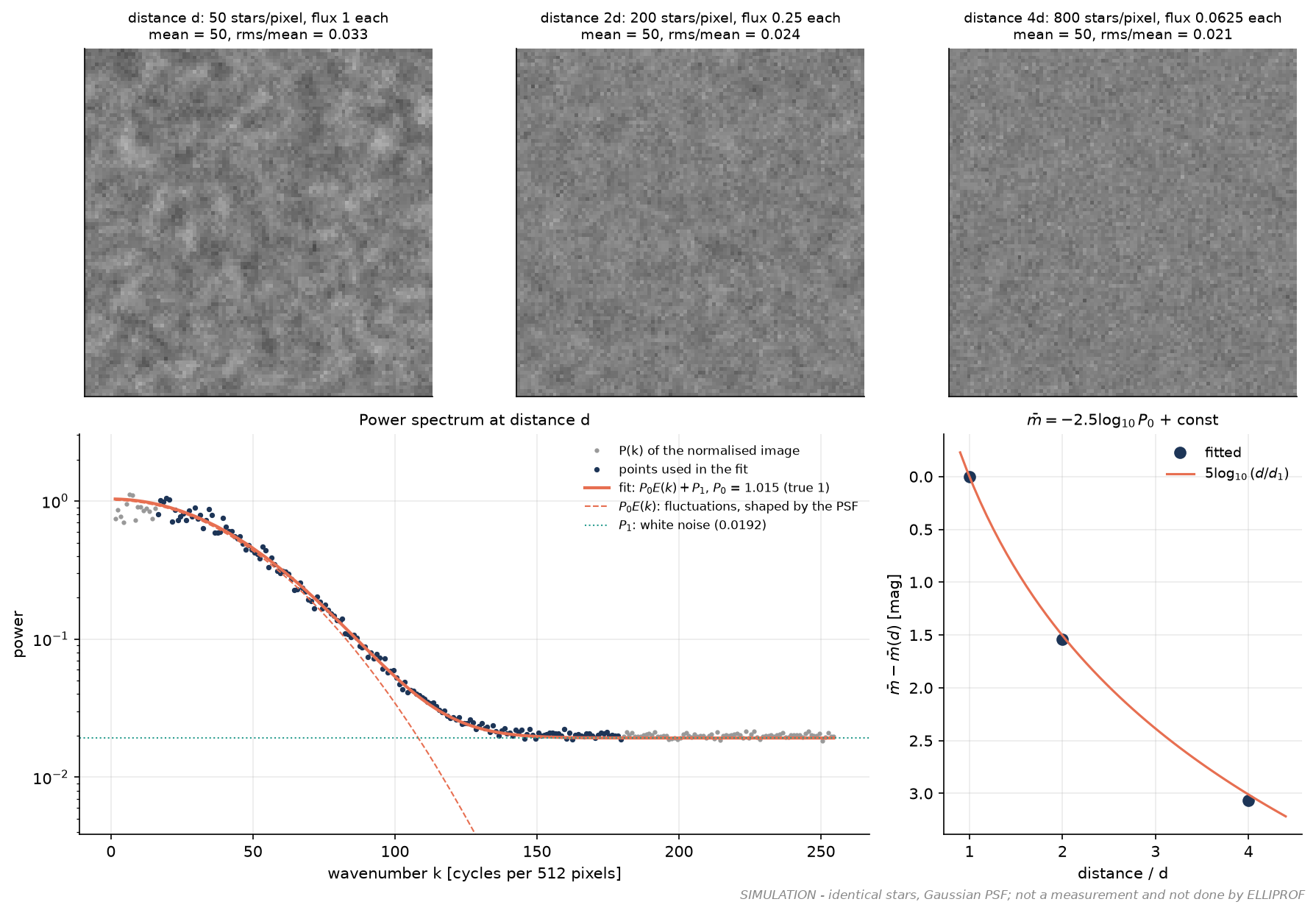
docs/scripts/make_sbf_power_spectrum_schematic.py)Why it works
Let a pixel at distance \(d\) contain on average \(\bar N\) stars, each of flux \(f\). The star count is Poisson-distributed, so
With distance, \(\bar N \propto d^2\) (a pixel covers more of the galaxy) and \(f \propto d^{-2}\). The mean (the surface brightness) does not depend on distance, but variance / mean falls as \(1/d^2\). Measuring the ratio of the fluctuation variance to the galaxy's mean brightness is therefore measuring the flux of a "typical" star, and hence the distance.
Real galaxies contain stars of many luminosities. The quantity measured is then the fluctuation flux
the ratio of the second to the first moment of the stellar luminosity function (\(n_i\) stars of flux \(f_i\)). It is dominated by the most luminous stars: red giants, and in the infrared the asymptotic giant branch (Tonry & Schneider 1988; Cantiello & Blakeslee 2023).
In magnitudes, the apparent fluctuation magnitude \(\bar m\) and the absolute fluctuation magnitude \(\bar M\) give the distance modulus:
The catch: the absolute fluctuation magnitude is not universal
\(\bar M\) depends on the stellar population: its age, its metallicity, and the filter. It is calibrated empirically as a function of galaxy colour, from galaxies with distances measured by other methods (Cepheids, the tip of the red giant branch). Stellar population models check it. The calibration is different for every filter and camera. The infrared fluctuations are brighter, but their calibration is more sensitive to the population (Jensen et al. 2003, 2015; Blakeslee et al. 2010). See Power spectrum and distance.
Why distances matter
Distances turn observed quantities (brightness, angular size) into physical ones (luminosity, size, mass). For galaxies beyond a few Mpc, accurate distances are rare and precious. SBF distances have been used to:
- map the three-dimensional structure of the Virgo cluster (Mei et al. 2007) and large-scale flows of galaxies (Tonry et al. 2000);
- measure the Hubble constant: \(H_0 = 73.3 \pm 0.7 \pm 2.4\) km/s/Mpc from infrared SBF distances to 63 galaxies (Blakeslee et al. 2021);
- calibrate Type Ia supernovae in early-type hosts, and improve the stellar and black-hole masses of massive galaxies (Jensen et al. 2021).
In this section
- ELLIPROF's role in SBF: why the galaxy model matters, and where ELLIPROF stops.
- Power spectrum and distance: from the residual to \(\bar m\), \(\mu\) and \(d\).
- Workflow and cautions: the full chain, and what can go wrong.
- History and references: from Tonry & Schneider (1988) to today, with verified references.
- Tutorial: A residual for SBF work.