Harmonic analysis with ELLIPROF
Real isophotes are not perfect ellipses. ELLIPROF measures how each
isophote departs from its best-fitting ellipse with harmonic terms:
patterns of extra and missing light that repeat 3, 4 or 6 times around
the ellipse. This page explains what is measured, how to read the
I3, A3, I4, A4 columns, how the harmonics enter the model image,
and how the original COS3X / COS4X settings and the modern options
map onto each other.
Everything here was checked against the original Fortran
(src/original/elliprof.f: routines FITCONTOUR, ALTER and SYNTHESIZE),
and the behaviour is covered by the test suite.
Why harmonics?
A smooth elliptical galaxy is described well by nested ellipses. Many galaxies are not quite that simple, and coherent departures from the ellipses carry information:
- boxy or disky isophotes (4th order), the classic structural diagnostic of elliptical galaxies;
- lopsided or egg-shaped isophotes (3rd order), for example from an off-centre component or an interaction;
- embedded disks and other components with a different shape or orientation, which show up as harmonic terms that change with radius;
- 6-fold structure (6th order), a finer shape term.
A detected harmonic does not prove a particular physical origin. The same terms also respond to things that have nothing to do with the galaxy's shape: dust lanes, spiral arms, a companion, a bright star that was not masked, a wrong centre, a wrong sky level or a poor mask. Always look at the residual image and check how the harmonics behave with radius before interpreting them.
What ELLIPROF fits
Along each ellipse, ELLIPROF samples the image at equal steps of the eccentric angle θ (up to 360 samples) and fits the samples by least squares with nine terms at once:
with m = 3 normally, or m = 6 in sixth-order mode.
(With LINEAR, \(I\) is fitted instead of \(\ln I\).)
- The 1st- and 2nd-order terms tell ELLIPROF how to move the
ellipse: the 1st order moves the centre, the 2nd order changes the
ellipticity and position angle. The constant and the cos 2θ term
update the isophote intensity
I0. - The 3rd/6th- and 4th-order terms are measured and reported, but ELLIPROF does not use them to move the ellipse.
Do higher orders affect the fitted geometry?
Not directly: only orders 0–2 are used to move the ellipse. But all
nine terms are solved simultaneously, so on an ellipse whose
samples are incomplete (masked regions, image edges) the terms are
not independent, and replacing the 3θ terms with 6θ terms can shift
the fitted lower-order coefficients a little. On UGC 12517, switching
to sixth order changes the fitted centre and ellipticity by less than
0.003 pixels and 0.0001 at well-sampled intermediate radii, but by up
to 0.55 pixels and 0.07 next to the masked nucleus and by up to
0.9 pixels in the outermost, partly masked isophotes. These numbers
are an example, not a general error estimate. COS4X and the size
of COS3X (0, 1, 2) never change the fit at all.
The convention
Each harmonic is reported as an amplitude and a phase:
| Column | Meaning |
|---|---|
I3, I4 |
amplitude of the 3rd/4th-order term as a fraction of I0 (dimensionless). In the default logarithmic fit, \(I_n = e^{\,a} - 1\), where \(a = \sqrt{c_n^2 + s_n^2}\) is the amplitude of the \(\ln I\) term; for small values this is simply \(a\). With LINEAR, \(I_n = a / I_0\) |
A3, A4 |
the phase in degrees of eccentric angle, \(A_n = \tfrac{1}{n}\,\mathrm{atan2}(s_n, c_n)\): the angle of the first maximum. Because a pattern of order n repeats every 360°/n, the phase is reduced to 0–120° for A3 and 0–90° for A4 |
| θ | eccentric angle, 0 at the end of the major axis that points at position angle alpha (counter-clockwise from +y; on the image this is the end towards −x) |
A3 and A4 are not position angles. They say where around the
ellipse the extra light is, relative to the major axis.

In 3rd-order mode, A3 can jump by 60° where the position angle wraps
alpha is reported in 0–180°. Where the fitted position angle of the
isophotes crosses 0°/180° (common for a galaxy whose major axis is
near the y axis, and for nearly round isophotes with an uncertain
angle), the end of the major axis that θ is measured from swaps to
the other end, which shifts θ by 180°. The phase of an order-n term
then shifts by 180°, counted modulo its period 360°/n:
| Order | Period of the phase | Effect of the 180° swap |
|---|---|---|
3rd (A3, COS3X ≥ 0) |
120° | 60° jump in A3 (half a period) |
4th (A4) |
90° | none (two whole periods) |
| 6th (A6) | 60° | none (three whole periods) |
So only the ordinary 3rd-order A3 jumps. It is a convention
effect, not a change in the galaxy. In
sixth-order mode the A3 column holds 2 × A6, and
since A6 does not jump, neither does that column. In the synthetic
test (a fixed pattern on a galaxy whose angle wraps from 179.9° to
2.0°), the 3rd-order A3 goes from 60.2° to 0.4°, while in
sixth-order mode the A3 column stays near 0.2° (0.1–0.4°) on both
sides, and A4 changes only smoothly with the twist.
Measuring versus modelling
Two separate questions are answered by two separate settings:
- Which order is measured? Always the 4th, and either the 3rd or the 6th. This changes the profile columns.
- Which measured terms go into the model image? None, the median value over all isophotes, or each isophote's own value (interpolated between isophotes). This changes only the model image and the residual, never the profile.
In the model image the included terms multiply the pure-ellipse model: model = smooth × [1 + I₃ cos 3(θ − A₃) + I₄ cos 4(θ − A₄)], with θ the eccentric angle of each pixel on the interpolated ellipse.
The harmonic modes
This is the authoritative table. Both the original concise settings
(COS3X=, COS4X=) and the descriptive options are fully supported and
run exactly the same code; the tests check that they give identical
profiles, models and residuals.
Third or sixth order: COS3X
| Legacy | Order measured | In the model | Modern equivalent of this value | Profile columns | Meaning |
|---|---|---|---|---|---|
COS3X=2 |
3θ | each isophote's term | 3 in --model-harmonics (default) |
I3, A3 = 3rd order |
measure and model the 3rd order |
COS3X=1 |
3θ | median term | 3 in --model-harmonics, --harmonic-mode median |
I3, A3 = 3rd order |
model one median 3rd-order term |
COS3X=0 |
3θ | none | 3 not in --model-harmonics |
I3, A3 = 3rd order |
measure the 3rd order, keep it out of the model |
COS3X=-2 |
6θ | each isophote's term | --sixth-order, 6 in --model-harmonics (default) |
I3 = 6th-order amplitude, A3 = 2 × 6th-order phase |
measure and model the 6th order |
COS3X=-1 |
6θ | median term | --sixth-order, 6 in --model-harmonics, --harmonic-mode median |
as above | model one median 6th-order term |
COS3X=-3 |
6θ | none | --sixth-order, 6 not in --model-harmonics |
as above | measure the 6th order only (recommended for 6th-order diagnostics) |
The sign of COS3X chooses the order measured (≥ 0: 3rd, < 0:
6th); its size chooses the use in the model (0 none, 1 median, 2
each).
The original program documents COS3X as 0/1/2 and "COS3X < 0: use
cos 6x instead of cos 3x". In the original code, every value ≤ −3
measures the 6th order and leaves it out of the model; the elliprof
package exposes COS3X=-3 as the supported spelling of that behaviour.
The package deliberately accepts exactly −3, −2, −1, 0, 1 and 2 (and
COS4X 0, 1, 2) and refuses other values, although the original code
would treat them like one of these.
Fourth order: COS4X
The 4th order is always measured (I4, A4).
| Legacy | In the model | Modern equivalent of this value |
|---|---|---|
COS4X=2 |
each isophote's term | 4 in --model-harmonics (default) |
COS4X=1 |
median term | 4 in --model-harmonics, --harmonic-mode median |
COS4X=0 |
none | 4 not in --model-harmonics |
Exact equivalences
The modern options always set COS3X and COS4X together:
--model-harmonics lists the terms put into the model (none, 3,
4, 3,4; with --sixth-order the 6th order is written 6), and
--harmonic-mode applies one mode (each or median) to all of them.
Every combination is one of these legacy pairs, and the tests check that
each pair and its modern spelling give identical profiles, models and
residuals:
| Legacy pair | Modern options |
|---|---|
COS3X=2 COS4X=2 |
(default), or --model-harmonics 3,4 |
COS3X=2 COS4X=0 |
--model-harmonics 3 |
COS3X=0 COS4X=2 |
--model-harmonics 4 |
COS3X=0 COS4X=0 |
--model-harmonics none |
COS3X=1 COS4X=1 |
--harmonic-mode median |
COS3X=1 COS4X=0 |
--model-harmonics 3 --harmonic-mode median |
COS3X=0 COS4X=1 |
--model-harmonics 4 --harmonic-mode median |
COS3X=-2 COS4X=2 |
--sixth-order |
COS3X=-2 COS4X=0 |
--sixth-order --model-harmonics 6 |
COS3X=-1 COS4X=1 |
--sixth-order --harmonic-mode median |
COS3X=-1 COS4X=0 |
--sixth-order --model-harmonics 6 --harmonic-mode median |
COS3X=-3 COS4X=2 |
--sixth-order --model-harmonics 4 |
COS3X=-3 COS4X=1 |
--sixth-order --model-harmonics 4 --harmonic-mode median |
COS3X=-3 COS4X=0 |
--sixth-order --model-harmonics none |
Four legacy pairs mix the two modes and have no modern spelling:
COS3X=2 COS4X=1, COS3X=1 COS4X=2, COS3X=-2 COS4X=1 and
COS3X=-1 COS4X=2. Use the legacy settings for those. Use either the
legacy settings or the modern options in one command, not both.
The same three runs in both styles:
# pure-ellipse model, harmonics still measured
elliprof n1234j.fits X0=514 Y0=514 R0=10 R1=450 NR=25 \
    -o n1234.dat -m n1234.prf --model-harmonics none

# 4th order (boxy/disky) in the model only
elliprof n1234j.fits X0=514 Y0=514 R0=10 R1=450 NR=25 \
    -o n1234.dat -m n1234.prf --model-harmonics 4

# measure the 6th order, do not model it
elliprof n1234j.fits X0=514 Y0=514 R0=10 R1=450 NR=25 \
    -o n1234.dat -m n1234.prf --sixth-order --model-harmonics none
# pure-ellipse model, harmonics still measured
elliprof n1234j.fits X0=514 Y0=514 R0=10 R1=450 NR=25 \
    -o n1234.dat -m n1234.prf COS3X=0 COS4X=0

# 4th order (boxy/disky) in the model only
elliprof n1234j.fits X0=514 Y0=514 R0=10 R1=450 NR=25 \
    -o n1234.dat -m n1234.prf COS3X=0 COS4X=2

# measure the 6th order, do not model it
elliprof n1234j.fits X0=514 Y0=514 R0=10 R1=450 NR=25 \
    -o n1234.dat -m n1234.prf COS3X=-3 COS4X=0
Which mode?
For users of the original program, the whole COS3X family in one grid
(the size of the value says how the term is used in the model, the sign
which order is measured):
| In the model | Measure 3θ | Measure 6θ | Measure 4θ (always) |
|---|---|---|---|
| each isophote's term | COS3X=2 (default) |
COS3X=-2 ⚠ |
COS4X=2 (default) |
| median term | COS3X=1 |
COS3X=-1 ⚠ |
COS4X=1 |
| not in the model | COS3X=0 |
COS3X=-3 |
COS4X=0 |
The same choices as decision diagrams; in italics, the modern options that give each value (they set both orders at once, see Exact equivalences):
flowchart LR
    Q{{"What should the<br/>I3, A3 columns measure?"}}
    Q -->|"3rd order"| T["COS3X ≥ 0<br/><i>(default)</i>"]
    Q -->|"6th order"| S["COS3X < 0<br/><i>--sixth-order</i>"]
    T --> T2["COS3X=2: in model, each isophote<br/><i>3 in --model-harmonics (default)</i>"]
    T --> T1["COS3X=1: in model, median<br/><i>3 in --model-harmonics,<br/>--harmonic-mode median</i>"]
    T --> T0["COS3X=0: measured only<br/><i>3 not in --model-harmonics</i>"]
    S --> S2["COS3X=-2 ⚠: in model, each isophote<br/><i>6 in --model-harmonics (default)</i>"]
    S --> S1["COS3X=-1 ⚠: in model, median<br/><i>6 in --model-harmonics,<br/>--harmonic-mode median</i>"]
    S --> S3["COS3X=-3: measured only<br/><i>6 not in --model-harmonics</i>"]
flowchart LR
F{{"4th order:<br/>always measured (I4, A4)"}}
F --> F2["COS4X=2: in model, each isophote<br/><i>4 in --model-harmonics (default)</i>"]
F --> F1["COS4X=1: in model, median<br/><i>4 in --model-harmonics,<br/>--harmonic-mode median</i>"]
F --> F0["COS4X=0: measured only<br/><i>4 not in --model-harmonics</i>"]The two modes marked ⚠ put a 6th-order term into the model and are subject to the known PA-wrap limitation.
Third order
A 3rd-order term is a pattern that repeats three times around the
ellipse: the isophote is pushed out at one end of the major axis and in
at the other, making it egg- or pear-shaped (see the figure above).
I3 gives its size and A3 its orientation.
Smooth, relaxed elliptical galaxies are nearly symmetric, so I3 is
usually small. A coherent 3rd-order signal over a range of radii points
to a lopsided light distribution: an off-centre component, a tidal
feature, a companion, or a problem such as a centre that is off or an
unmasked source on one side. Random residual structure (noise, faint
sources) gives I3 and A3 that change erratically from isophote to
isophote; when I3 is at the noise level, A3 is meaningless.
Keep the 3rd order in the model (default) when you want the model to
follow the galaxy as closely as possible. Keep it out (COS3X=0)
when you want the residual to show the asymmetric structure itself.
Fourth order: boxy and disky isophotes
The 4th-order term is the classic measure of boxy and disky isophotes.
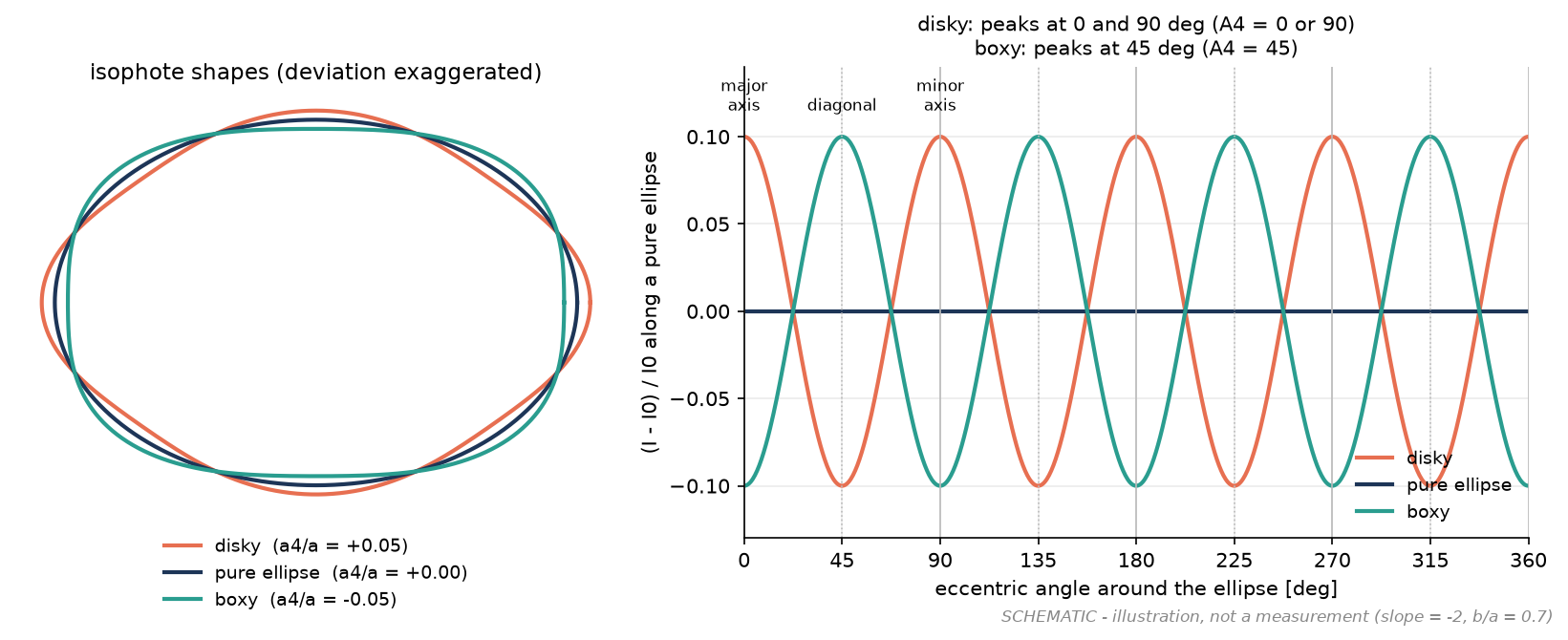
A4 near |
Extra light on the ellipse | Shape |
|---|---|---|
| 0° (≡ 90°) | along the major and minor axes | disky (pointed, "lemon-shaped") |
| 45° | along the diagonals | boxy (squared-off) |
A4 = 0° and A4 = 90° are the same pattern, because
cos 4(θ − 90°) = cos 4θ: a 4th-order pattern repeats every 90°. Moving
A4 from 0° to 45° rotates the pattern by half a period and turns
"pointed along the axes" into "pointed along the diagonals". I4 gives
the size of the deviation; it is always positive, and the sign of the
boxy/disky shape is in the phase, not in I4.
Converting to a4/a
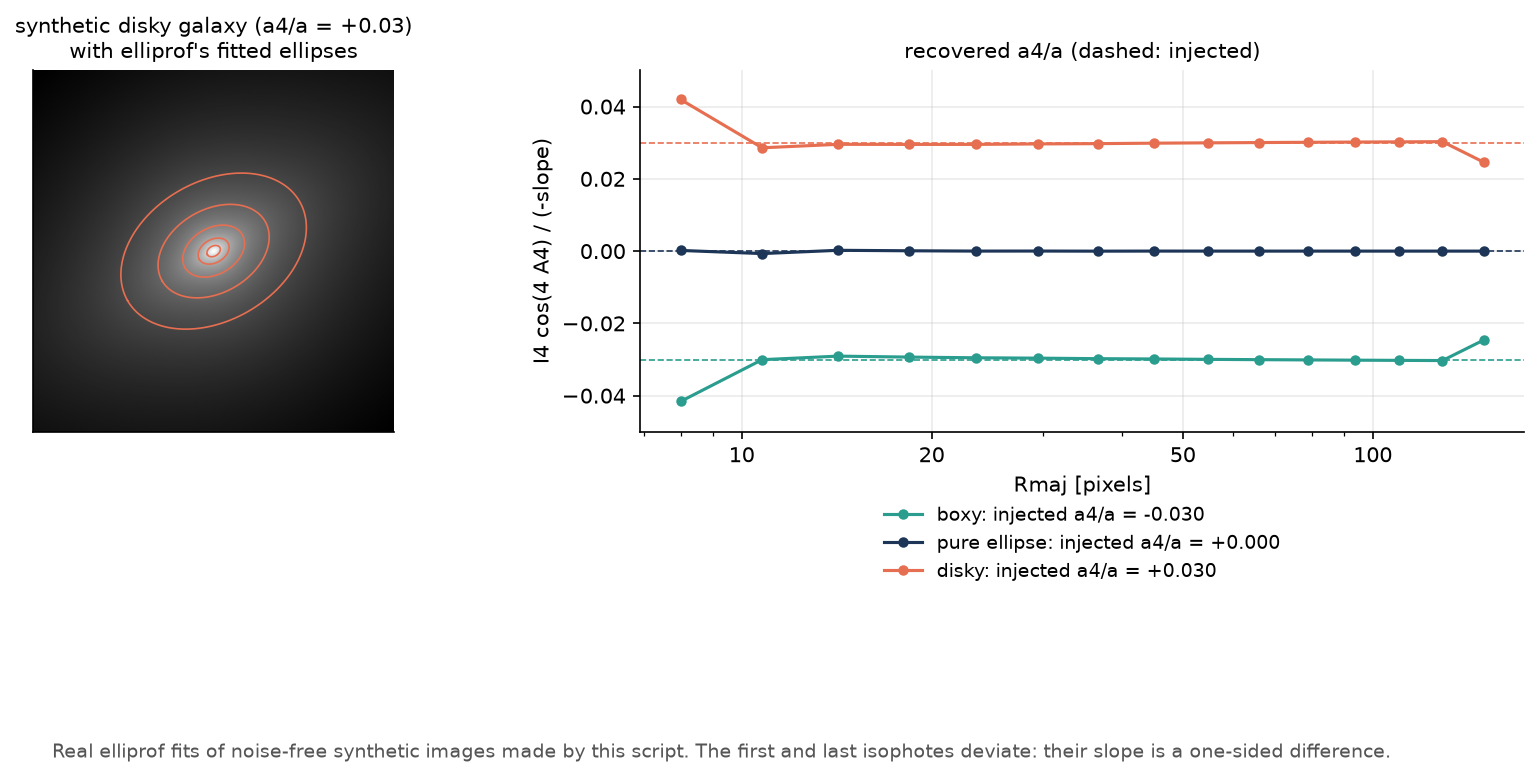
In the literature, boxiness is usually quoted as a4/a: the cos 4θ coefficient of the isophote's radial deviation from the ellipse, divided by the semi-major axis, positive for disky and negative for boxy isophotes. ELLIPROF measures an intensity deviation along a fixed ellipse instead, and the local intensity gradient converts one into the other.
If the isophote lies a small distance δr outside the ellipse at some θ, the ellipse there samples slightly brighter light: δ ln I ≈ (−slope) · δr / r, with slope = d ln I / d ln r (negative for a galaxy). With δ ln I ≈ I₄ cos 4(θ − A₄), the cos 4θ part of δr/r is
and every term is in the profile (I4, A4, slope). It is a
first-order approximation: it assumes small deviations, uses
ELLIPROF's finite-difference slope, takes \(e^{a}-1 \approx a\), and
follows this sign convention (other programs differ). It is not the
I4 column itself.
The same reasoning gives \(a_3/a \approx I_3\cos(3A_3)/(-\text{slope})\) for the 3rd order, but its sign depends on which end of the major axis θ is measured from (see the A3 warning above).
Other programs, other conventions
Other isophote-fitting programs report the 4th-order term with different normalisations and sign conventions (for example, a "B4" intensity coefficient, or a radial coefficient divided by a gradient). Convert every catalogue to a4/a before comparing.
Sixth order
A 6th-order term repeats six times around the ellipse: six small lobes, finer than the 4th-order box/disk pattern (see the first figure).
ELLIPROF measures it in place of the 3rd order, using the same two
fitting slots and the same output columns. That is why it is selected by
a negative COS3X (--sixth-order).
In sixth-order mode, I3 and A3 are not 3rd-order quantities
There are no I6 or A6 columns. With COS3X < 0:
I3holds the 6th-order amplitude (fraction ofI0);A3holds twice the 6th-order phase: A3 = 2 × A6, in 0–120° (A6 itself is in 0–60°);- the 3rd order is not measured at all;
- the 3rd-order rule that
A3jumps by 60° at a position-angle wrap does not apply: neither A6 nor thisA3column jumps (see above).
ELLIPROF's printed table labels the columns I(6x) and A(6x) in this
mode. The .dat profile and the CSV keep the column names I3, A3;
the CSV adds a header line saying Harmonic order: 6, and the profile
records the negative COS3X in its run settings
(read_profile(...).attrs["flags"]).
Because A3 = 2 A6, the argument 6 A6 is 3 A3, and the radial 6th-order deviation is
Sixth order changes what is measured, and through the simultaneous
fit it can change the fitted geometry a little where an ellipse is
poorly sampled (see What ELLIPROF fits). Whether
the 6th-order term also goes into the model is chosen by the size of
COS3X, as for the 3rd order.
Sixth-order models across a position-angle wrap
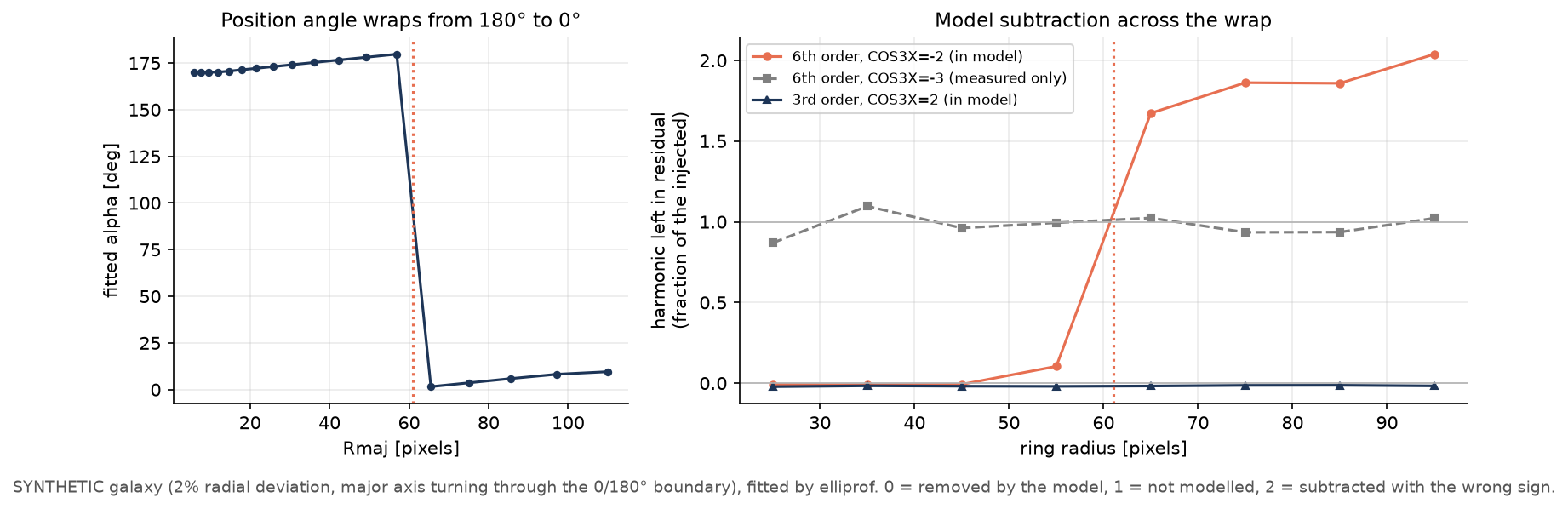
If the fitted position angle of the isophotes crosses the 0°/180° boundary, the original model synthesis (SYNTHESIZE) gives the 6th-order term the wrong sign beyond that radius. It corrects the phase for the swapped end of the major axis in a way that is right for the 3rd order but not for the 6th.
- The measured 6th-order profile (
I3,A3) is correct on both sides of the wrap. - The model and the residual are wrong beyond the wrap in the two
modes that put the 6th order into the model:
COS3X=-2(--sixth-order) andCOS3X=-1(--sixth-order --harmonic-mode median). There the 6th-order structure is subtracted with the wrong sign, so the residual holds about twice the signal instead of none. - elliprof warns when this happens (it names the isophote where the angle wraps), and does not change the model: the original numerical code is kept exactly as it is.
- Measurement only,
COS3X=-3(--sixth-order --model-harmonics none), avoids the problem and is the recommended mode for 6th-order diagnostics.
UGC 12517 is affected: in its sixth-order fit the angle wraps already at the 2nd isophote (11.7 pixels), so almost the whole 6th-order model is affected (elliprof's warning names that isophote). This is pre-existing behaviour of the original ELLIPROF, not something introduced by the package.
A second, older observation: with a 6th-order term in the model, the model can have a few NaN pixels at the very centre, inside the innermost isophote.
Modelling the harmonics: a controlled example
On synthetic galaxies whose isophotes carry a known 2% radial deviation of order 3, 4 or 6, elliprof recovers the deviation (0.0200, 0.0200 and 0.0199 through the formulae above), the other orders stay at the noise level (no cross-talk), and putting the matching term into the model removes about 98% or more of that pattern from the residual:
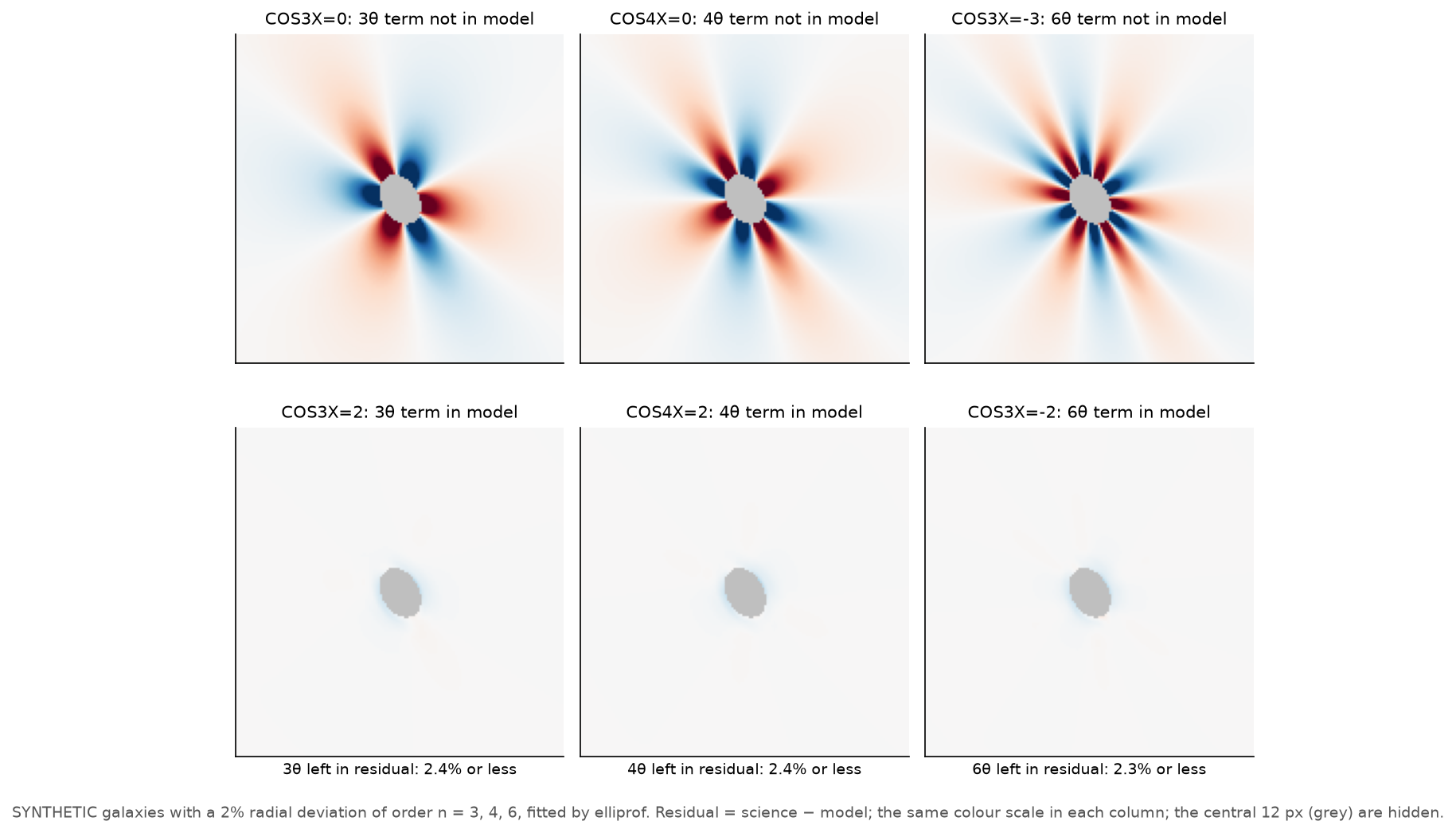
Real galaxies are rarely this clean: noise, masks, dust and several components all mix into the measured terms.
Real data: UGC 12517
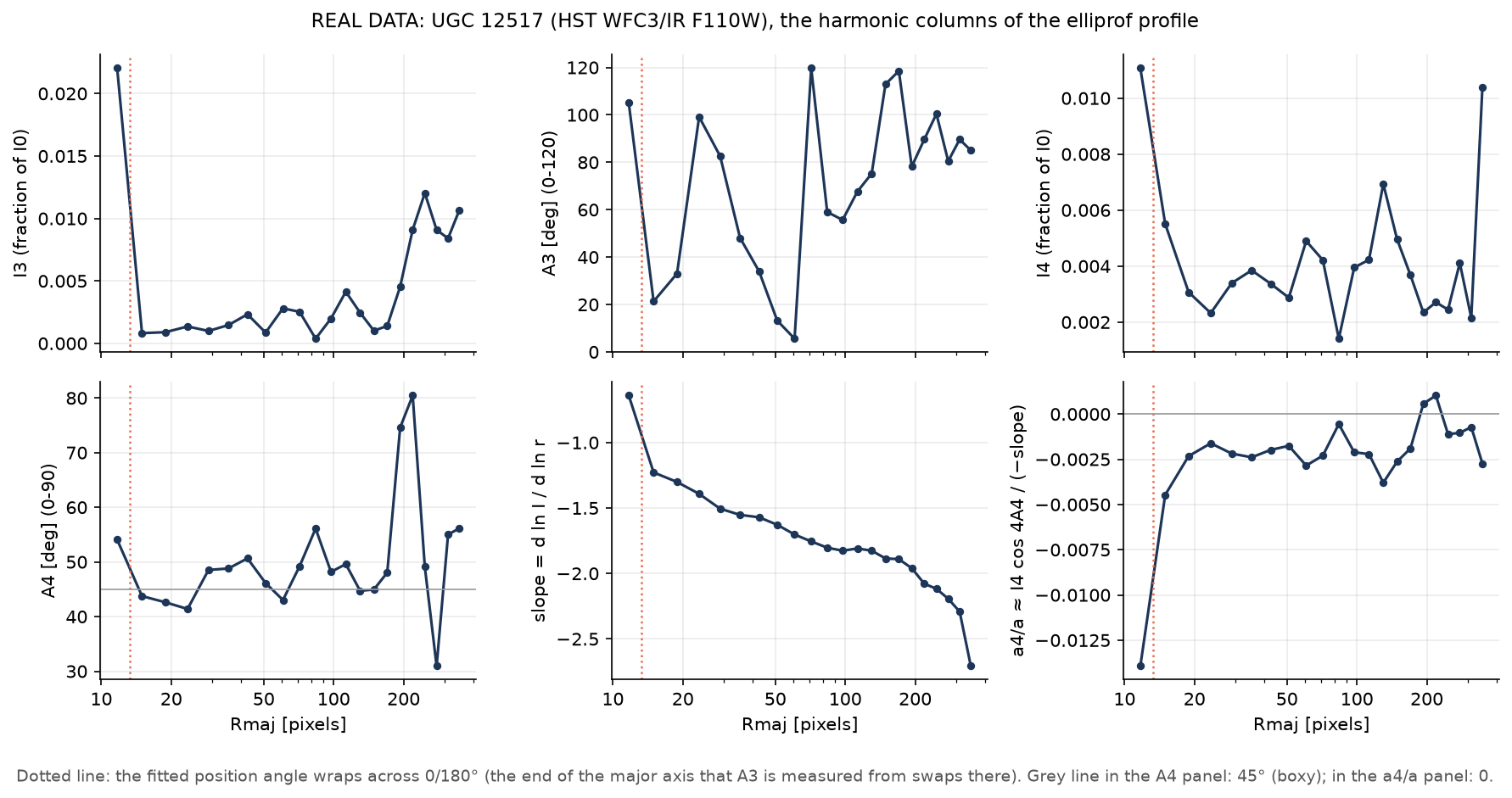
I4is about 0.002–0.007 andA4mostly 40°–55°, so a4/a is between about −0.005 and +0.001: nearly pure ellipses, if anything slightly boxy.I3is about 0.001–0.003 at intermediate radii. At that levelA3is not well determined, and it scatters over its whole range.- The innermost fitted isophote (11.7 pixels) borders the masked nucleus and the outermost ones are faint and partly masked; treat their harmonics with care.
Significance
ELLIPROF's profile does not include uncertainties. A deviation of a few tenths of a percent is small. Before interpreting it, estimate the noise, for example by refitting with different masks, sky levels or starting parameters, or by fitting simulated images with the same noise.
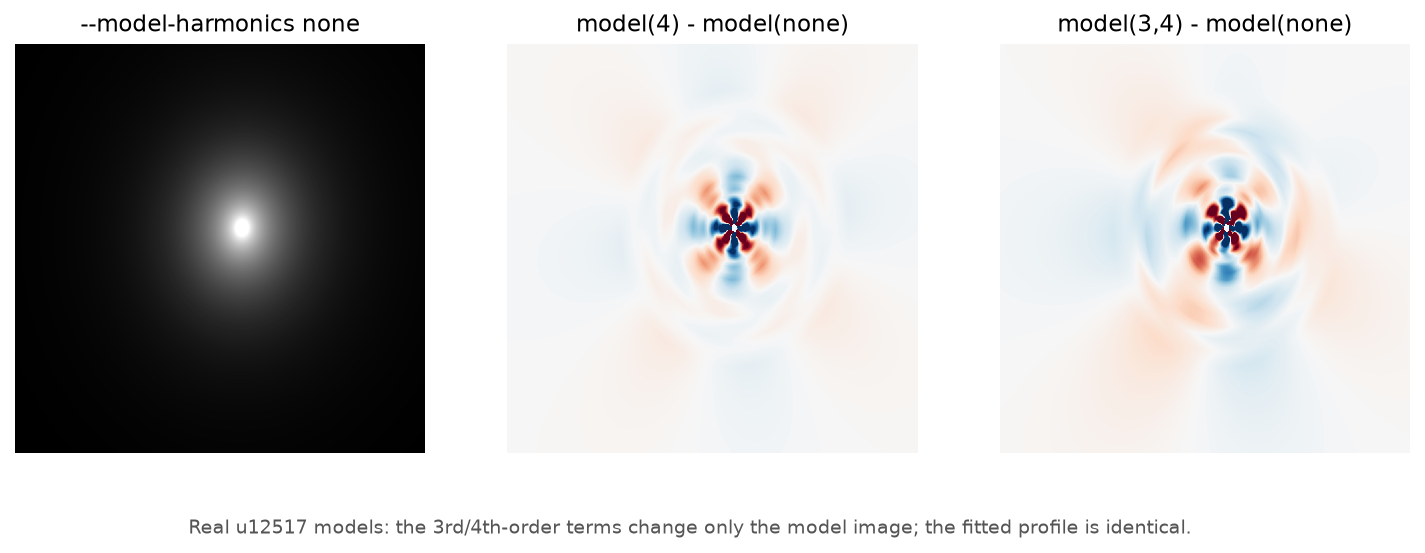
The harmonics change the model image of UGC 12517 by a small, structured amount (the fitted profile is identical in all three runs):
Harmonics and SBF distances
For surface brightness fluctuation work, the smooth galaxy model is subtracted and the fluctuations are measured in the residual. A model with the wrong shape leaves coherent residual structure: four-fold "butterfly" patterns from boxy or disky isophotes, an embedded disk, or large-scale asymmetric patterns. Such structure adds power at low spatial frequencies and can bias the fluctuation measurement, so the harmonic terms in the model matter.
More terms are not automatically better. A harmonic term can absorb real structure that should be masked or studied (dust, spiral arms, a companion), or compensate for a wrong sky level, mask or centre. Choose the model harmonics by looking at the profile (are the terms coherent with radius?), the residual image, and how the result changes between settings. ELLIPROF provides the galaxy model and residual; the fluctuation analysis itself is done downstream (see ELLIPROF's role in SBF).
Why it matters
The 4th-order shape of elliptical galaxies correlates with other properties. Disky ellipticals tend to be rotation-supported and of lower luminosity. Boxy ellipticals tend to be more luminous, slowly rotating, and more often radio-loud and X-ray bright. This was the basis of Kormendy & Bender's (1996) proposal to divide ellipticals into disky and boxy types. See Kormendy, Fisher, Cornell & Bender (2009) for a detailed study. Harmonic analysis of isophotes goes back to work including Jedrzejewski (1987).
- Jedrzejewski, R. I. 1987, MNRAS, 226, 747, doi:10.1093/mnras/226.4.747
- Kormendy, J. & Bender, R. 1996, ApJ, 464, L119, doi:10.1086/310095
- Kormendy, J., Fisher, D. B., Cornell, M. E. & Bender, R. 2009, ApJS, 182, 216, doi:10.1088/0067-0049/182/1/216
See also: How ELLIPROF fits a galaxy, the command-line reference, UGC 12517, step by step.