ELLIPROF's role in SBF
The scope boundary
What ELLIPROF does: it fits elliptical isophotes to the galaxy and builds a smooth model of it. elliprof then writes the residual, mask × (science − sky − model), with the science image's header and WCS.
What ELLIPROF does not do: estimate the sky; make the mask; detect or correct for globular clusters and background galaxies; normalise the residual; compute or fit the power spectrum; measure the PSF; apply a calibration; or give a distance.
ELLIPROF is one component of an SBF measurement: the galaxy model, and through it the residual. The rest is done by other software and by the researcher, and needs judgement that no single program should hide.
ELLIPROF in published SBF analyses
ELLIPROF has historically been used as the galaxy-modelling component of surface brightness fluctuation analyses. It fits and subtracts the smooth galaxy light distribution, producing the galaxy-subtracted image used in the subsequent SBF processing. The power-spectrum measurement, the contaminant corrections, the calibration and the distance determination are separate, downstream steps.
The published record:
- The I-band SBF Survey. Tonry et al. (1997) describe the step as fitting "a galaxy model to the summed, cleaned, sky-subtracted galaxy image" and subtracting it. The ACS Virgo Cluster Survey papers identify that software as ELLIPROF. Jordán et al. (2004) write that "galaxies were modeled using the ELLIPROF program described in the SBF survey of Tonry et al. (1997)". Mei et al. (2005a) call ELLIPROF "the isophotal fitting software that has been used for the SBF survey by Tonry et al. 1997".
- The ACS Virgo Cluster Survey (HST/ACS). Jordán et al. (2004) and Mei et al. (2005a) fitted a smooth model to each galaxy with ELLIPROF and subtracted it. They then removed the remaining large-scale residuals with a SExtractor background model before detecting sources and measuring the SBF.
- Infrared SBF with HST/WFC3 (the MASSIVE and Type Ia supernova host galaxies). Jensen et al. (2021) made an elliptical model of each galaxy "using the ELLIPROF routine", first to help determine the background level and then, after background subtraction, as the smooth galaxy model. They saved that model "for later use to normalize the SBF power spectrum", and list ELLIPROF among the software used.
In all of these, ELLIPROF supplies the galaxy model. The SBF measurement itself is the downstream chain described on Power spectrum and distance and Workflow and cautions. The full references are on History and references.
The same program
The elliprof package runs the original ELLIPROF fitting and model
code, compiled unchanged (see
How elliprof is built). The published
analyses above used ELLIPROF within their own pipelines and
environments. This package makes the same fitting and model code
available on its own. It does not reproduce those pipelines.
Why the galaxy model matters
The fluctuations are tiny compared with the galaxy itself. In the simulation, the pixel-to-pixel rms is only a few percent of the mean, and in real data it is often much less. Before they can be measured, the smooth galaxy must be removed very accurately:
- Any error in the model is a large-scale pattern in the residual. That puts power at low wavenumbers in the power spectrum, where the fluctuation signal is also measured.
- The model is also needed to normalise the residual. The fluctuation variance is proportional to the local galaxy brightness, so the residual is divided by \(\sqrt{\text{model}}\) to make the fluctuation amplitude uniform across the image.
A model built from fitted isophotes follows the galaxy's changing ellipticity, orientation and boxy/disky shape with radius, so it removes the galaxy closely. The published analyses above also describe where such models fall short: Jordán et al. (2004) report that for seven galaxies with strong disk components ELLIPROF could not produce acceptable models. Jensen et al. (2021) fitted the remaining residual patterns (from neighbouring galaxies, dust lanes, shells, spiral structure or bars) with a spline and avoided the affected regions and low wavenumbers.
Model harmonics and the residual
Include the 3rd- and 4th-order terms in the model (the default,
--model-harmonics 3,4), so that boxy or disky isophotes do not
leave a 4-fold pattern in the residual. Compare with
--model-harmonics none to see how much they matter for your galaxy.
See Harmonic analysis.
The residual ELLIPROF provides
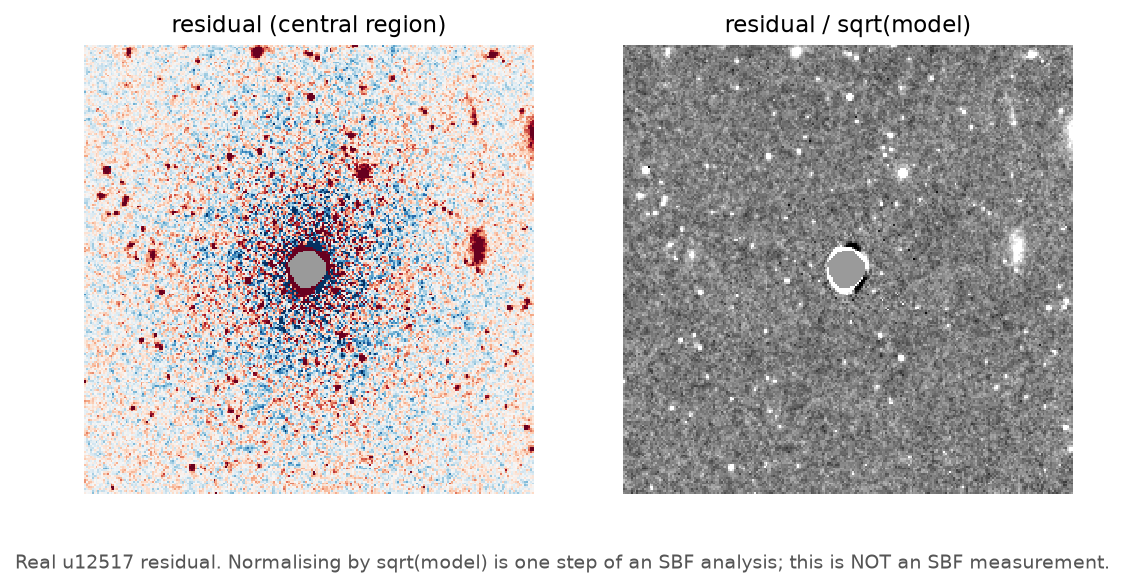
elliprof galaxy.fits --mask mask.fits --sky SKY \
    X0=... Y0=... R0=... R1=... NR=... NITER=10 \
    -m galaxy.prf --residual galaxy_residual.fits
What you get:
galaxy_model.fits: the smooth model, relative to the sky, covering the whole image;galaxy_residual.fits: science − sky − model on good pixels, exactly 0 on masked pixels;- both in float32, with the science image's WCS, pixel for pixel aligned with it.
The tutorial walks through this for UGC 12517 and shows what to check before handing the residual on.
What a residual is not ready for yet
An ELLIPROF residual still contains:
- large-scale structure that the model did not follow (a residual sky gradient, dust, faint disks). SBF analyses usually remove it with a further smoothing step;
- point sources: globular clusters and background galaxies. They add their own fluctuations and must be masked down to a limit, with the contribution of fainter, undetected ones estimated from their luminosity functions;
- the noise of the detector and the sky.
These are all downstream steps; see Workflow and cautions.