UGC 12517, step by step
This tutorial fits the elliptical galaxy UGC 12517 in detail. It uses
the HST WFC3/IR F110W image in the repository's
examples/u12517
folder. Every figure on this page was made from real elliprof 0.1.3
output, by the scripts in docs/scripts/.
Before you start
Install elliprof (Install) and download
u12517j.fits and u12517j.dmask as in the
quick start. DS9 is useful but not required.
1. Look at the data
| Image | u12517j.fits: 1025 × 1022 pixels, HST WFC3/IR, F110W filter |
| Pixel scale | 0.128″ / pixel |
| Mask | u12517j.dmask: 0 = masked, 1 = good; 103,402 pixels (9.9%) masked |
| Sky | 3246 (image units; from the original analysis) |
| Galaxy centre | near pixel (567, 562) in ELLIPROF coordinates |
Open the image in DS9 with a log or asinh scale. You will see a smooth, slightly elongated elliptical galaxy, many compact background galaxies and a few bright stars with diffraction spikes. The mask covers these, the nucleus and the image edges. See the preparation chain.
2. Choose the parameters
- Centre
X0=567 Y0=562: the peak of the galaxy. Remember that ELLIPROF coordinates are DS9 pixel numbers minus 0.5. - Radii
R0=9 R1=347: from the edge of the masked nucleus out to a large ellipse that still lies inside the image. The major axis is nearly vertical, and 562 ± 347 stays within the 1022 rows. - Number
NR=23, spaced in \(r^{1/4}\) (the defaultRLAW=2). - Iterations
NITER=10: more than the default 5, to be sure that the parameters settle. RMSTAR, to reject faint stars and knots the mask missed.
3. Run
elliprof u12517j.fits \
    --mask u12517j.dmask --sky 3246 \
    X0=567 Y0=562 R0=9 R1=347 NR=23 NITER=10 RMSTAR \
    -o u12517.dat --csv u12517.csv --reg u12517.reg \
    -m u12517.prf \
    --prepared u12517_prepared.fits --residual u12517_residual.fits
It takes well under a second. The note about "too few usable samples" refers to the innermost isophote, which lies inside the masked nucleus (see the quick start).
4. Check the fit on the image
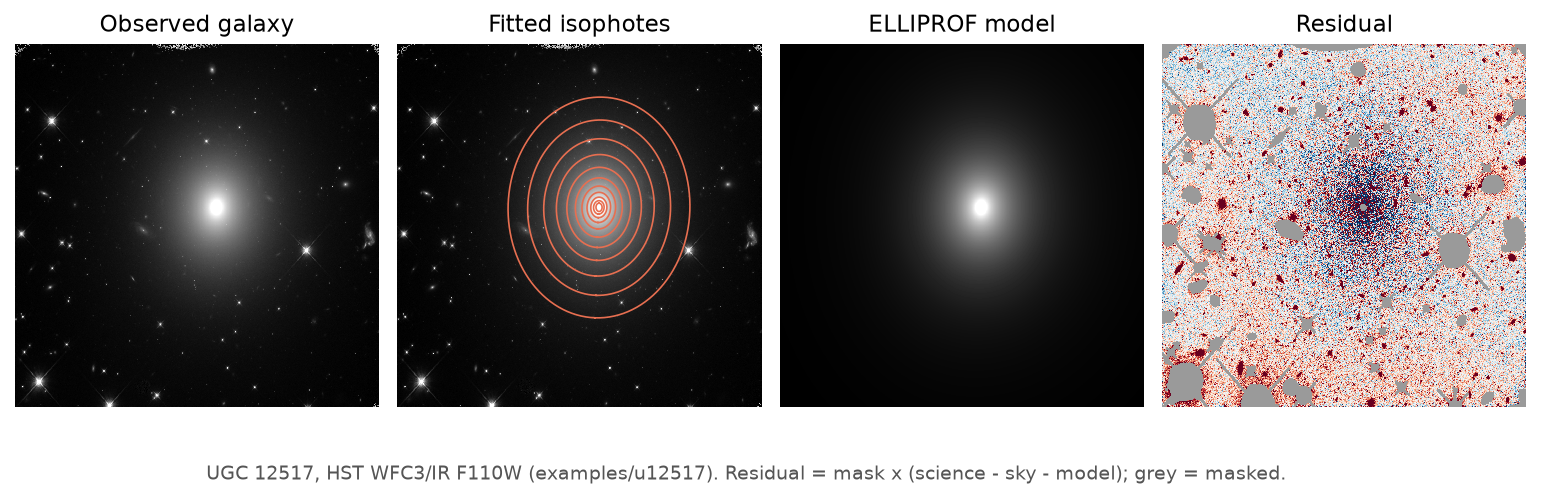
Things to check:
- the ellipses are nested and do not cross;
- they follow the galaxy's light, not a star or a background galaxy;
- the outer ones stay on the image.
5. Read the profile
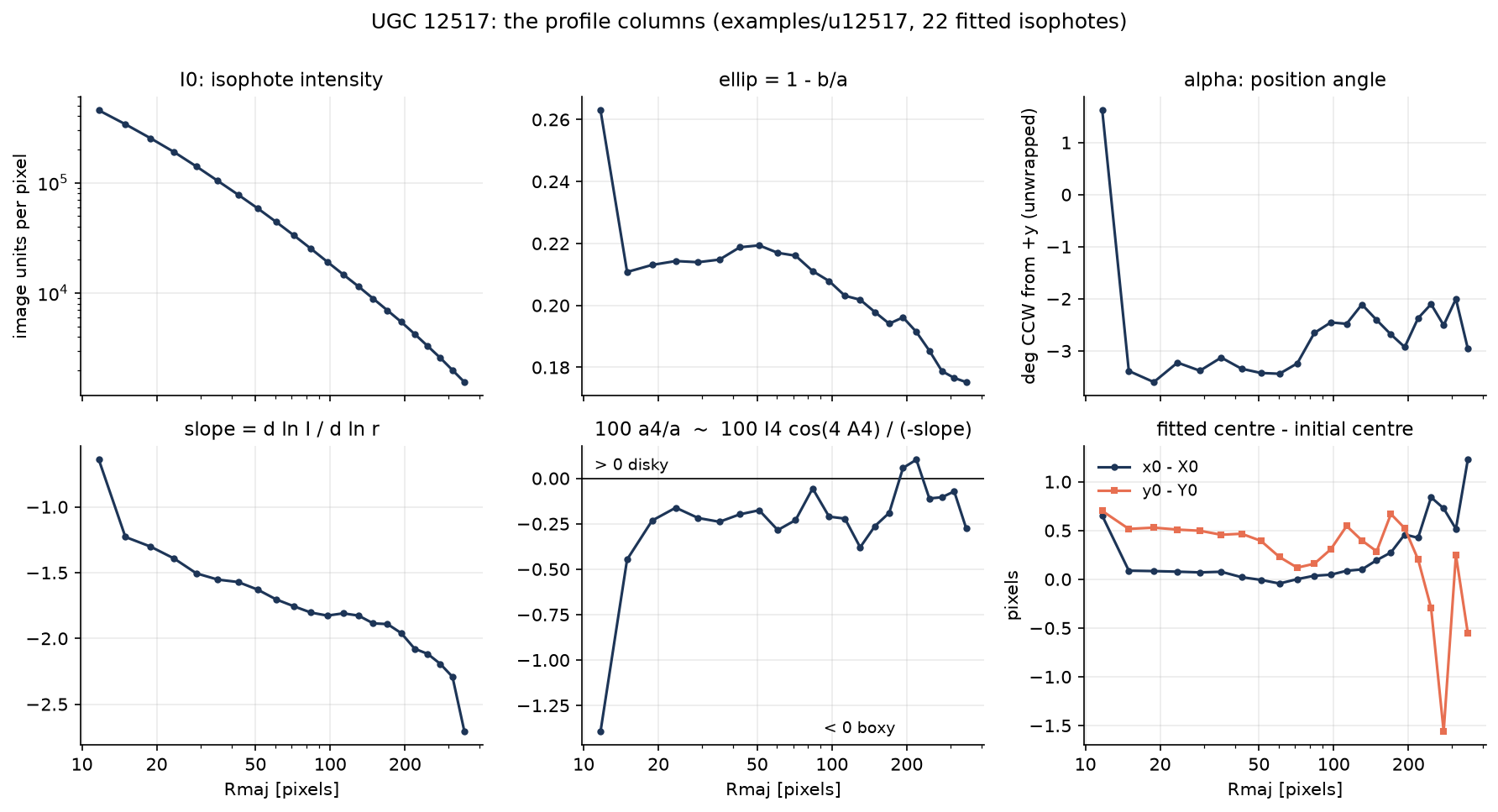
The interpretation is on The profile.
In short: a smooth profile, ellipticity 0.21 falling to 0.175 outside,
no isophote twist, nearly pure ellipses (|a4/a| < 0.5%), and stable
centres. The harmonic columns (I3, A3, I4, A4) of this fit are
plotted and discussed in
Harmonic analysis.
6. Surface brightness
The profile above is in the image's units, I0 per pixel. Converting it
to mag/arcsec² takes a photometric zeropoint and the pixel scale; see
Galaxy surface photometry
for the formula.
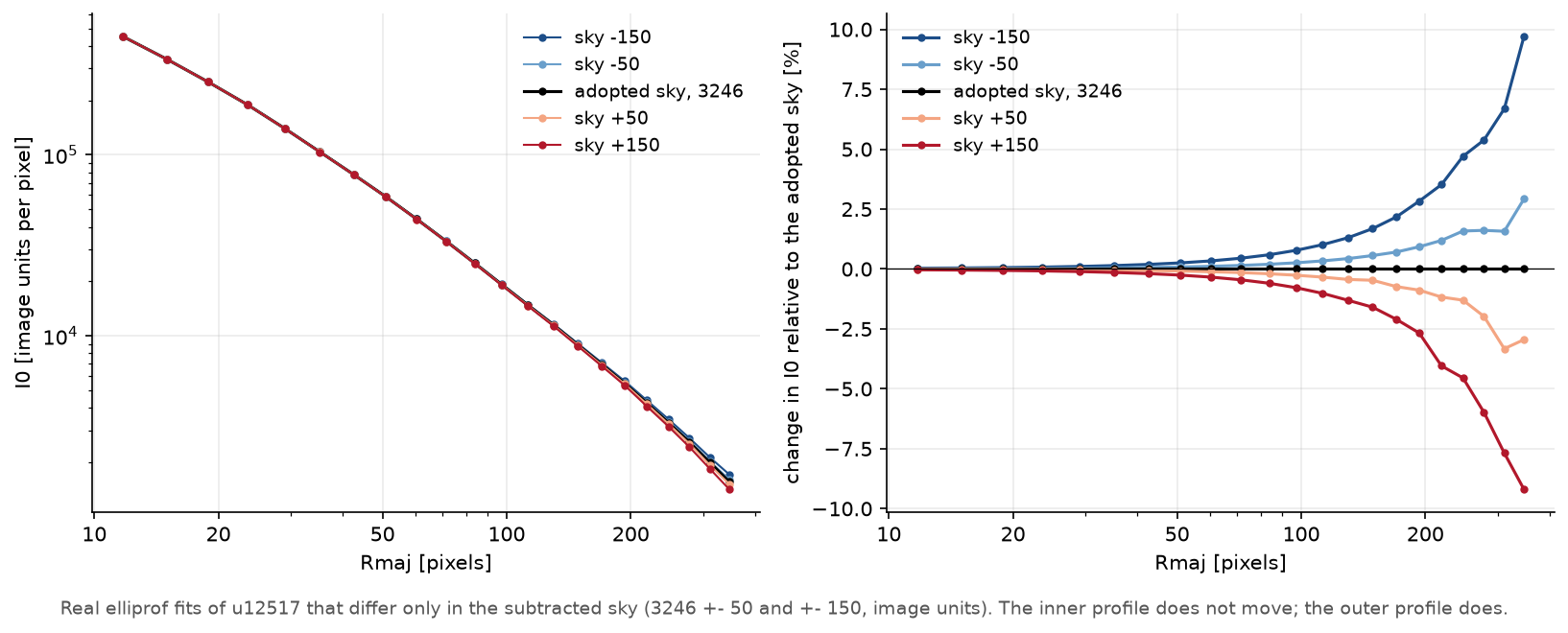
7. Test the sky
Re-run with the sky changed by its uncertainty, and compare:
for SKY in 3196 3246 3296; do
    elliprof u12517j.fits --mask u12517j.dmask --sky $SKY \
        X0=567 Y0=562 R0=9 R1=347 NR=23 NITER=10 RMSTAR -o sky_$SKY.dat
done
8. Look at the model and the residual
Open u12517.prf and u12517_residual.fits in DS9 next to the
image, locked by WCS.
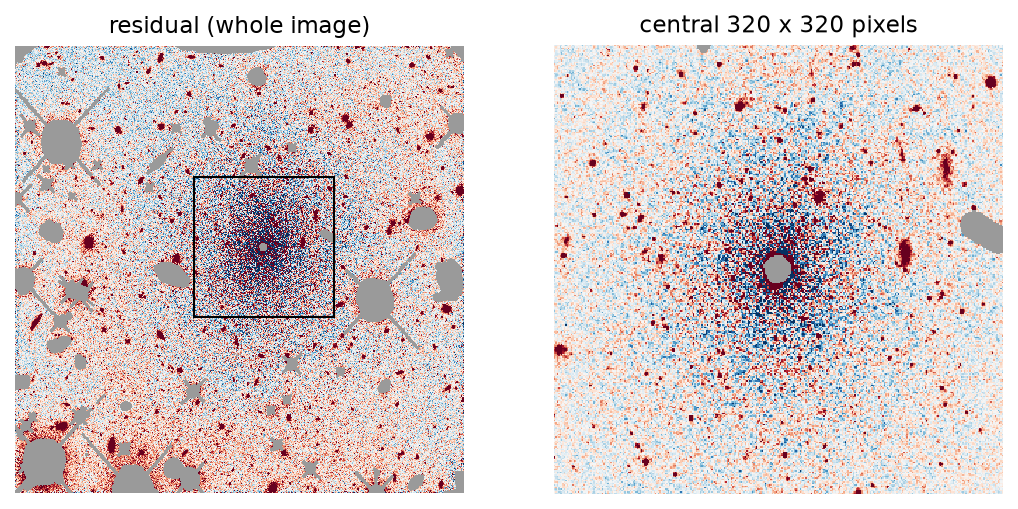
At this display stretch, the residual is mostly noise and faint point sources. No obvious dust lane, shell or disk stands out, which is consistent with the nearly pure elliptical isophotes. A deeper look needs smoothing and a harder stretch. The small pattern at the centre is where the galaxy is brightest and its profile steepest, so small model errors are largest there.
9. In Python
from elliprof import run_elliprof

r = run_elliprof("u12517j.fits", x0=567, y0=562, r0=9, r1=347, nr=23,
                 niter=10, rmstar=True, mask="u12517j.dmask", sky=3246,
                 model_path="u12517.prf", prepared="u12517_prepared.fits",
                 residual_path="u12517_residual.fits", output_dir=".")
p = r.profile.iloc[1:]           # the r = 9 isophote was not fitted
The full set of plots on this page is made by
docs/scripts/make_all.py in the repository.
Next
- A residual for SBF work: what to check before an SBF analysis.
- Common mistakes.