What is an isophote?
An isophote is a curve of constant surface brightness on the sky: every point on it is equally bright. For a smooth galaxy, the isophotes are nested closed curves, bright near the centre and fainter outwards.
In elliptical galaxies, lenticulars and bulges, the isophotes are very close to ellipses. The ellipses need not share one centre, one shape or one orientation. Measuring how they change with radius is one of the basic tools of galaxy structure. That is what ELLIPROF does: it describes the galaxy as a set of nested ellipses, one per radius, and measures each one.
In one sentence
ELLIPROF slices the galaxy into rings of equal brightness and records, for each ring, how bright it is, where its centre is, how flattened it is, which way it points, and how much it differs from a perfect ellipse.
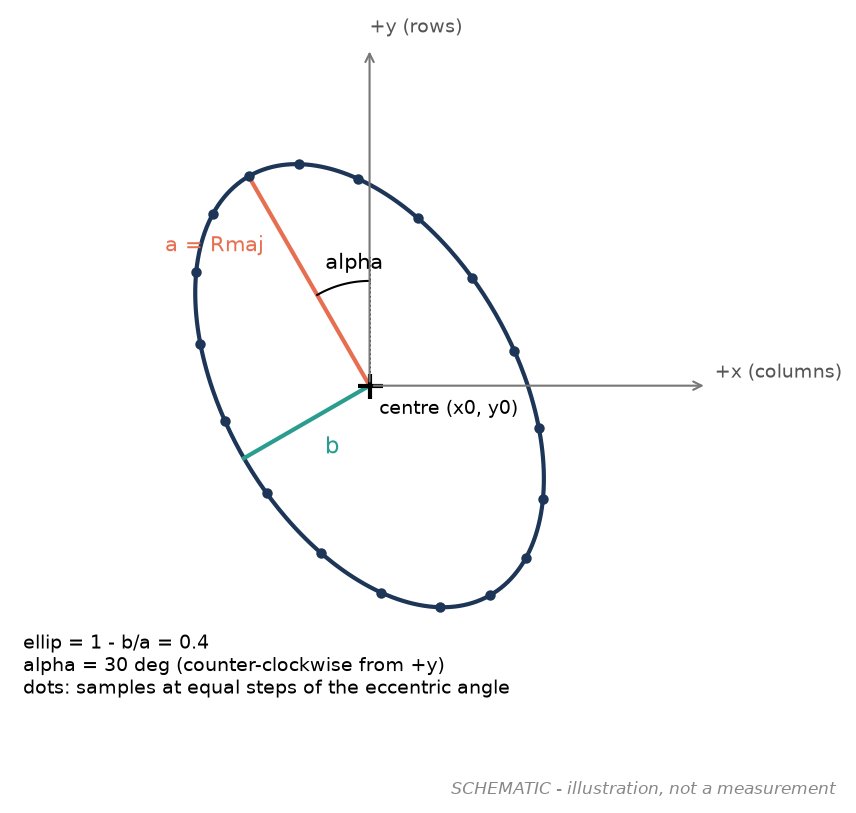
The geometry of one isophote
| Quantity | Profile column | Meaning |
|---|---|---|
| semi-major axis \(a\) | Rmaj |
half the longest diameter, in pixels. This is the "radius" of the isophote |
| semi-minor axis \(b\) | (from ellip) |
half the shortest diameter |
| ellipticity | ellip |
\(\epsilon = 1 - b/a\). 0 for a circle, larger for flatter ellipses |
| position angle | alpha |
direction of the major axis, in degrees (0–180), counter-clockwise from the image +y axis |
| centre | x0, y0 |
the fitted centre of this isophote, in pixels |
| intensity | I0 |
brightness of the isophote, in image units per pixel, after the sky is subtracted |
Position angle convention
ELLIPROF measures alpha counter-clockwise from the +y axis of the
image (the pixel rows), not from north. Measured from +x, the major
axis is at alpha + 90°. To get a sky position angle (east of north),
you must also use the image orientation from its WCS. An angle of 0°
and one of 180° are the same axis. For example, 3° and 177° differ by
only 6°.
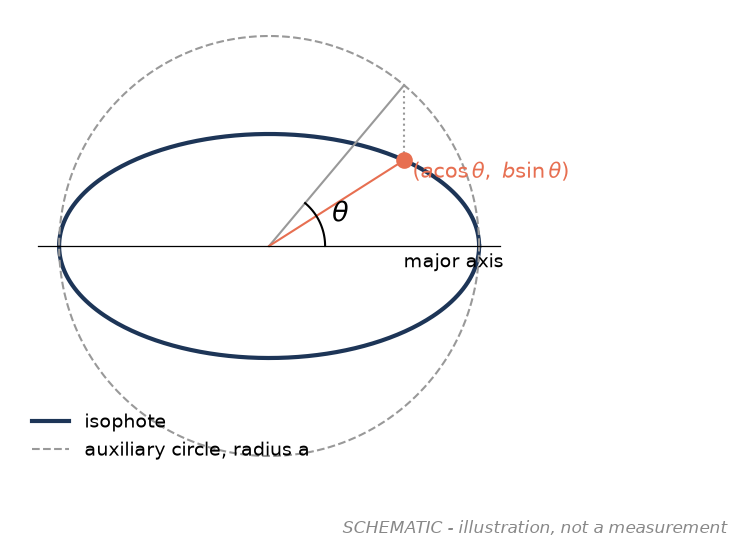
The eccentric angle
ELLIPROF measures positions around each ellipse with the eccentric angle \(\theta\), not the ordinary polar angle. A point on the ellipse is
in the ellipse's own frame (major axis along \(x\)). Geometrically, \(\theta\) is the angle on the circle of radius \(a\) drawn around the ellipse.
The harmonic phases A3 and A4 (see
Harmonic analysis) are angles of this kind. They
are not position angles.
Surface brightness and the profile
The intensities I0 of the isophotes, as a function of semi-major axis,
form the galaxy's surface-brightness profile. Together with how
ellip, alpha and the centre change with radius, this is the
profile that ELLIPROF writes. See The profile.
In magnitudes per square arcsecond, after a photometric calibration (Galaxy surface photometry):
where \(s\) is the pixel scale in arcseconds and \(m_1\) the magnitude of one unit of image flux.
Why isophotes change with radius
Real galaxies are not perfect nested ellipses, and the ways they depart from that are informative:
- Ellipticity changes reflect the 3-D shape, or an embedded disk.
- Position-angle twists (
alphachanging with radius) can mean a triaxial galaxy seen in projection, or an interaction. - Centre shifts can mean asymmetry, dust or a disturbed galaxy. Fits near masked regions, or at very low surface brightness, also shift.
- Boxy or disky isophotes (the 4th-order term) are linked to how the galaxy formed. See Harmonic analysis.
Isophote fitting in the literature
ELLIPROF's approach is to sample the image along each ellipse, expand the intensity in a Fourier series of the angle, and use the low-order terms to correct the ellipse. The same approach underlies other isophote-fitting programs, notably the method described by Jedrzejewski (1987, MNRAS 226, 747). ELLIPROF is an independent implementation with its own conventions. Check the conventions on How ELLIPROF fits a galaxy before comparing numbers between programs.
Next: How ELLIPROF fits a galaxy.