How ELLIPROF fits a galaxy
This page describes what ELLIPROF does between reading your image and
writing the profile, and which parameters control each step. The keyword
names (NITER=, RLAW= ...) are the same on the command line and, in
lower case, in Python.
Overview
- Prepare the image:
prepared = mask × (science − sky). (Sky and masks) - Choose the radii:
NRsemi-major axes fromR0toR1, spaced byRLAW. - Start every isophote at your initial centre (
X0,Y0), with a rough position angle and ellipticity. ELLIPROF estimates these from the image at the half-way radius (R0 + R1)/2; withELLIP=eit uses your ellipticity instead. -
Iterate
NITERtimes. In each iteration, for every isophote:- sample the image along the current ellipse (up to 360 points);
- optionally reject bright star-like samples (
RMSTAR); - fit the intensity around the ellipse with a constant plus harmonics of orders 1, 2, 4 and 3 (or 6), all at once;
- use the 1st- and 2nd-order terms to move the centre and to change the ellipticity and position angle, so that the ellipse follows the isophote.
Then update the logarithmic slopes of all the isophotes.
-
Write the profile and, when
-m(or--residual) asks for it, build the model image.
The workflow
flowchart TD
    subgraph PKG ["elliprof package: preparation"]
        A["Science FITS image<br/>any BITPIX, read as 32- or 64-bit float"] --> B["subtract the sky<br/>--sky or --sky-image"]
        B --> C["apply the mask: bad pixels set to 0<br/>--mask, --mask-convention"]
    end
    C --> P[("prepared image<br/>--prepared")]
    subgraph ORIG ["original ELLIPROF: unchanged Fortran"]
        D["starting geometry: X0, Y0 given;<br/>PA and ellipticity estimated at (R0+R1)/2<br/>(or ELLIP=)"]
        E["radial grid: NR semi-major axes<br/>from R0 to R1, spaced by RLAW"]
        F["for each isophote: sample up to 360 points<br/>at equal steps of eccentric angle<br/>(pixels = 0 skipped; AVG; RMSTAR)"]
        G["least squares, 9 terms at once:<br/>constant, 1θ, 2θ, 4θ, and<br/>3θ (COS3X ≥ 0) or 6θ (COS3X < 0)"]
        H["move the ellipse with orders 0–2:<br/>centre, ellipticity, PA, I0;<br/>record I3, A3, I4, A4"]
        I["after every isophote is done:<br/>TIE smoothing, FIXCTR=2 median centre,<br/>logarithmic slopes"]
        J["radial profile"]
        K["model synthesis, only with -m or --residual:<br/>ellipses interpolated between isophotes,<br/>times (1 + harmonic terms chosen by<br/>COS3X and COS4X)"]
        D --> E --> F --> G --> H
        H -- "next isophote" --> F
        H -- "last isophote" --> I
        I -- "repeat: NITER iterations (default 5)" --> F
        I -- "after NITER iterations" --> J
        J --> K
    end
    P --> D
    J --> O1["profile: -o (text, n1234.dat),<br/>--csv, --reg"]
    K --> O2["model image: -m (FITS, n1234.prf)"]
    K --> R["residual = mask × (prepared − model)<br/>--residual"]
    P --> R
The steps in the first box, and the files written at the end, are done
by the elliprof package around the original program: reading any
FITS data type, subtracting the sky, applying the mask, and writing the
profile, model, prepared and residual files. The steps in the second box
are the original ELLIPROF routines (FITPROFILE,
GETCONTOUR, TRIMIT, FITCONTOUR, ALTER and SYNTHESIZE in
src/original/elliprof.f), compiled unchanged. Between the fit and the
model, ELLIPROF also fits a de Vaucouleurs law to the profile and prints
the result; it is not used for the model.
One iteration visits every isophote once (sample, fit, move the
ellipse), then smooths the parameters if TIE is set and updates the
slopes. NITER=n or --niter n sets how many iterations are run; the
default, 5, is the original program's own.
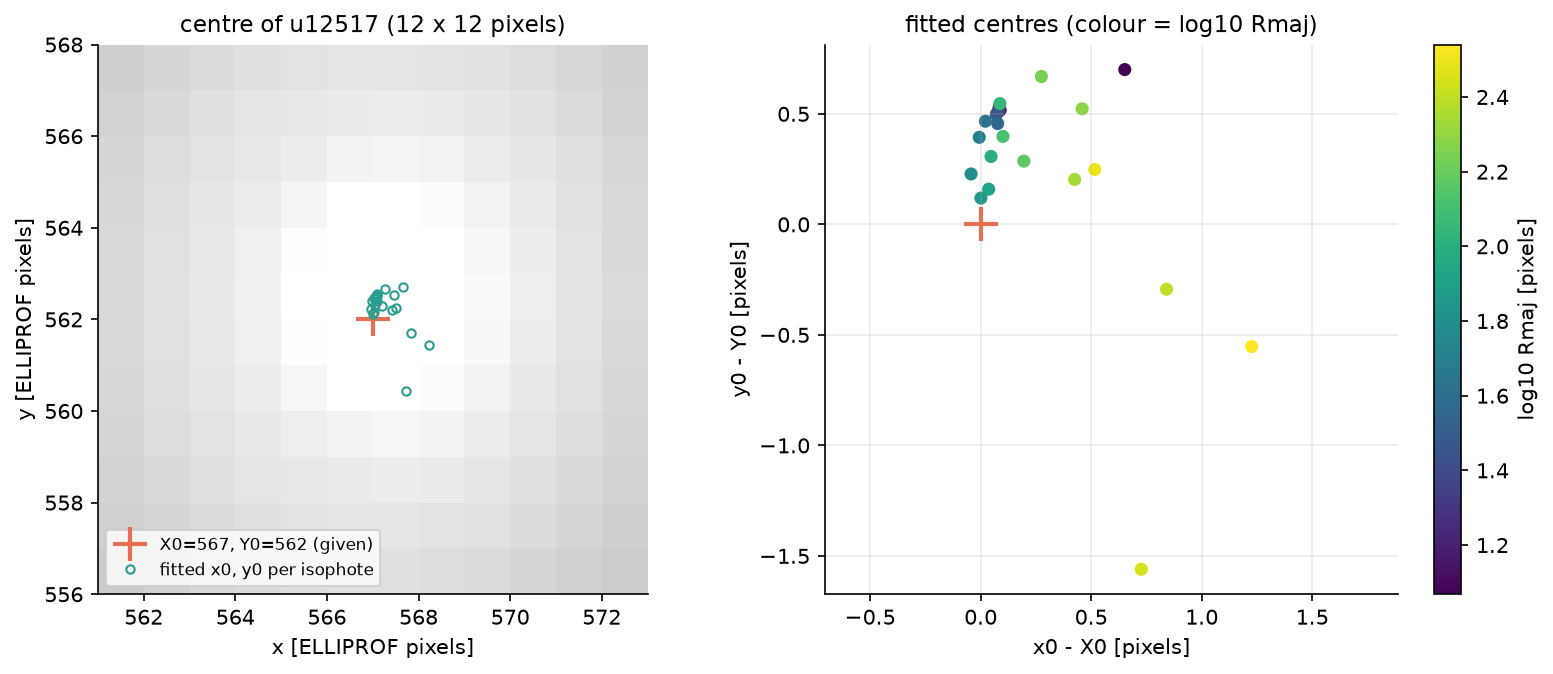
1. The initial centre and the fitted centres
ELLIPROF does not find the galaxy for you. You give the starting
centre X0, Y0. Every isophote then fits its own centre, which is
reported as x0, y0 in the profile.
FIXCTR= |
Centres |
|---|---|
| 0 (default) | each isophote fits its own centre |
| 1 | all centres fixed at X0, Y0 |
| 2 | after each iteration, all centres are set to the median of the fitted centres |
ELLIPROF pixel coordinates
ELLIPROF puts the centre of the pixel in FITS column i at x = i − 0.5, and likewise for rows. That is half a pixel less than FITS and DS9 pixel numbers. A galaxy centred on DS9 pixel (567.5, 562.5) has ELLIPROF centre (567, 562). The DS9 region files that elliprof writes are already converted.
A poor starting centre (off by more than a few pixels, or on a star) can
make the inner isophotes wander. Give the best centre you can, and check
the x0, y0 columns.
2. The radii: R0, R1, NR and RLAW
R0 and R1 are the semi-major axes, in pixels, of the innermost and
outermost isophotes (0 < R0 < R1). NR (2 to 100) is the number of
isophotes, including both ends. RLAW decides how they are spaced:
RLAW= |
Spacing |
|---|---|
| 2 (default) | equal steps in \(r^{1/4}\) |
| 1 | equal steps in \(\log r\) (geometric) |
| 0 | equal steps in \(r\) (linear) |
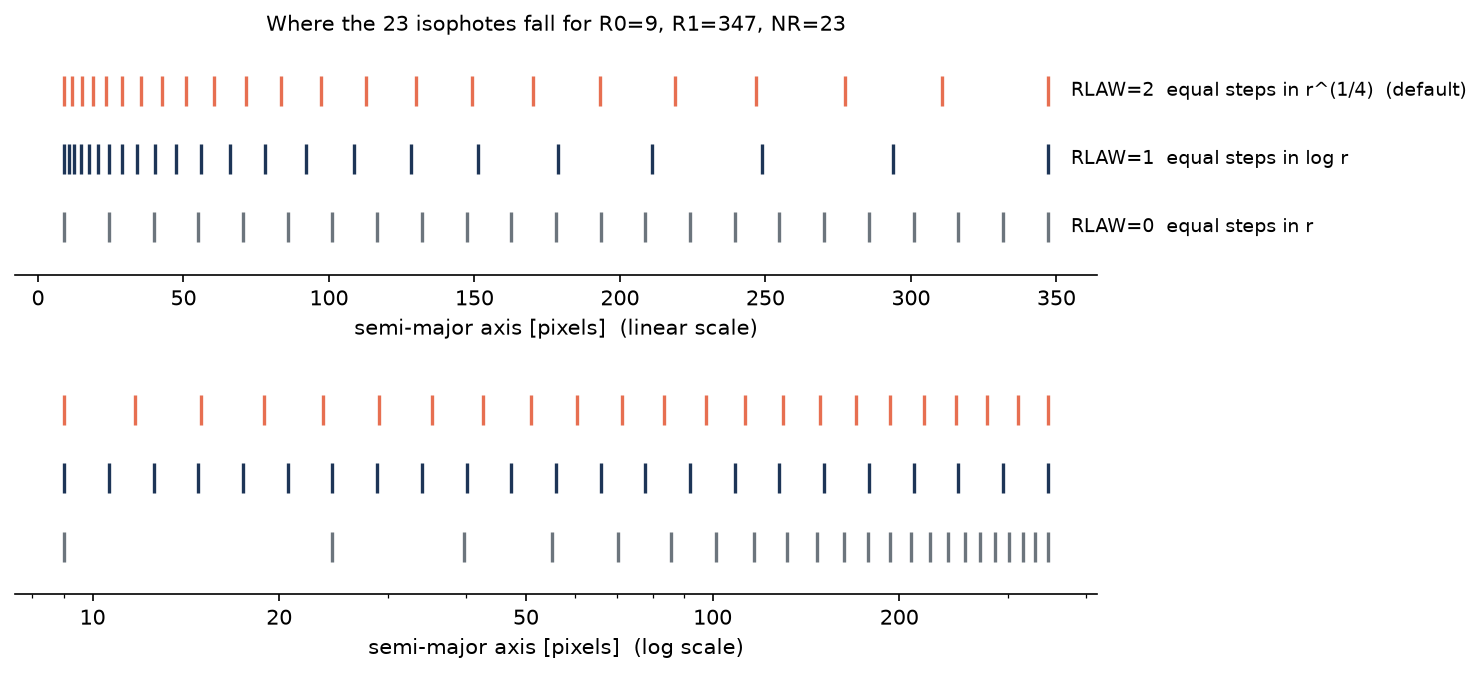
The default \(r^{1/4}\) spacing samples the bright inner galaxy closely without wasting isophotes in the faint outskirts. It suits the de Vaucouleurs-like profiles of elliptical galaxies.
3. Sampling one ellipse
Along each ellipse ELLIPROF takes up to 360 samples at equal steps of the
eccentric angle. By default each
sample is interpolated bilinearly between the four nearest pixels. With
AVG=n, it is instead a weighted average over a (2n+1) × (2n+1) box, and
samples with more than 20% masked weight are skipped. Pixels that are
exactly 0 are ignored. That is how the mask acts.
If an ellipse has too few usable samples (for example, it lies inside a masked region), that isophote keeps its previous parameters, and elliprof reports it in a note.
4. Fitting the harmonics
The samples around the ellipse are fitted by least squares, all nine terms at once, with
by default, where m = 3, or m = 6 with --sixth-order (COS3X < 0).
With LINEAR, \(I\) itself is fitted instead of \(\ln I\).
- Orders 1 and 2 measure how the ellipse is off: a 1st-order term
means the centre is off, and a 2nd-order term means the ellipticity or
position angle is off. ELLIPROF converts them into corrections and
moves the ellipse. The constant and the cos 2θ term update
I0.GAIN=gscales the corrections, andELLIP=eholds the ellipticity fixed. - Orders 3 (or 6) and 4 are measured and reported as
I3,A3,I4,A4, and are not used to move the ellipse. Because all nine terms are solved together, the 3rd/6th-order choice can still shift the fitted geometry slightly where an ellipse is poorly sampled. See Harmonic analysis.
After each iteration, the logarithmic slope of every isophote is updated from its neighbours:
At the first and last isophotes this becomes a one-sided difference. Positive values (intensity increasing outwards) are replaced by −2.
5. Iterations: NITER
One iteration visits every isophote once. NITER (default 5, 1 to
1000) sets how many iterations are run; on the command line --niter N
is the same as NITER=N, and in Python it is niter=. The default of 5
is the original ELLIPROF's own. Increase it when the parameters are still
changing between the last iterations, for example after a poor starting
centre. The keyword VERBOSE prints the parameters after every
iteration, so you can see whether they have settled.
NITER is the only iteration count of the isophote fit. The original
code has fixed internal limits elsewhere (for example in the
de Vaucouleurs fit it prints at the end), but they do not affect the
profile, the model or the residual, and they are not parameters.
TIE=k smooths the parameters with radius after each iteration. With
k ≥ 0 it fits a weighted polynomial of order k in \(r^{1/4}\). With k < −1
it takes a running binomial average over |k| isophotes. The default,
−1, applies no smoothing.
6. Rejecting stars: RMSTAR
With RMSTAR, the samples along each ellipse that are brighter than
(\(Q_3\) is the upper quartile) are ignored in that iteration. Only bright outliers are rejected, one sample at a time.
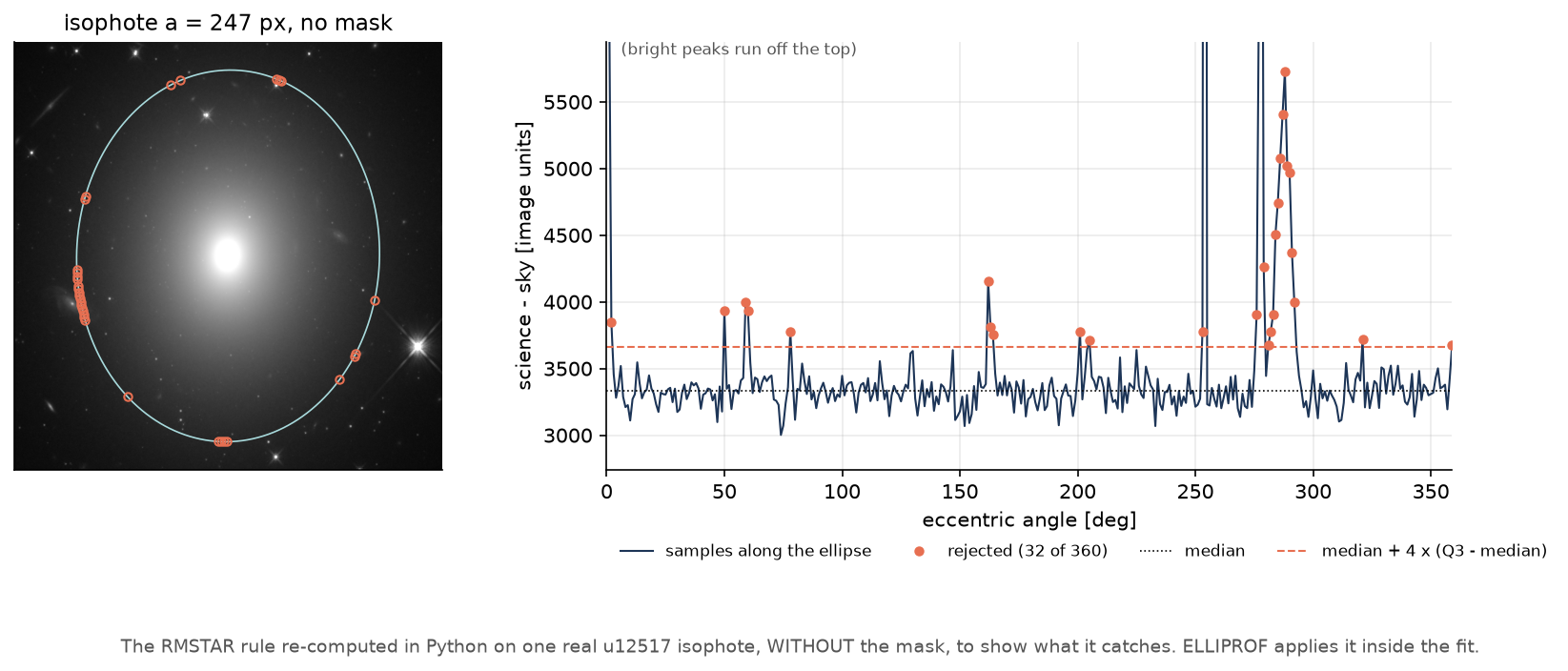
RMSTAR is not a substitute for a mask
The original code also intends to drop the samples next to each
rejected one, but that loop has no effect, so only the bright samples
themselves go. The wings of a star below the threshold stay in the
fit. Mask extended or bright contaminants with --mask, and use
RMSTAR for faint stars and knots that the mask missed.
7. The model image
With -m FILE, ELLIPROF builds a 2-D model of the galaxy from the fitted
isophotes and elliprof writes it as FITS (no MODEL keyword is needed
since 0.1.4). The model is built after the fit is finished, so asking for
it never changes the profile. The model follows the fitted
intensity, centre, ellipticity and position angle with radius, plus the
3rd- and 4th-order terms you choose (model harmonics).
It covers the whole image, masked pixels included.
Inside R0 and beyond R1
The model also has values inside the innermost and beyond the outermost fitted isophote, where it is extrapolated from the profile. Only the region between R0 and R1 is constrained by the fit.
Other keywords
| Keyword | Effect |
|---|---|
SCALE=s |
image scale in arcsec/pixel; only recorded in the profile |
SKY=s |
ELLIPROF's own sky level, used only by the de Vaucouleurs fit printed at the end. It does not change the image or the profile. Use --sky to subtract a sky |
GC |
globular-cluster mode: circular annuli around a centre that ELLIPROF finds itself |
See the command-line reference for everything.